
AI-Based Cyber Attack Detection
Authentication, and the Evidentiary Gap for Deepfake Detection Outputs

The rapid advancement of artificial intelligence in cybersecurity has created a critical evidentiary gap in the judicial system, as no federal standard currently governs how AI deepfake detection outputs enter the legal record. While AI-based phishing detection and biometric authentication offer robust defense mechanisms—reducing credential theft by approximately 50%—they also introduce significant liability risks due to false positive rates of up to 3.5% and unresolved Fourth Amendment surveillance concerns. Current frameworks like Federal Rule of Evidence 901 and the 2023 amendment to Rule 702 struggle to address the probabilistic nature of machine-generated inferences, leading to inconsistent court rulings, such as the September 2025 dismissal of a California civil case involving alleged deepfake testimony. With emerging state laws like Louisiana Act No. 250 and Colorado’s Privacy Act setting new precedents, and proposed Federal Rule 707 undergoing public review as of early 2026, organizations must navigate a complex landscape of NIST IR 8596 compliance and BIPA litigation to mitigate legal exposure.
Executive Summary
No federal evidentiary standard governs how an AI deepfake detection output enters a judicial record, and courts applying Federal Rule of Evidence 901 must do so without specialized guidance. The absence of a targeted standard has already produced material consequences: in September 2025, an Alameda County, California civil court dismissed a case after concluding that videotaped witness testimony was a fabricated deepfake, with the court relying on judicial discretion rather than any codified detection protocol. At the federal level, the Judicial Conference released proposed Rule 707, titled Machine-Generated Evidence, for public comment in August 2025, with the comment period closing February 16, 2026, but the rule applies only where a proponent affirmatively acknowledges that evidence was AI-created, leaving contested deepfakes entirely outside its scope.
Louisiana became the first state to address AI-generated evidence directly with Act No. 250 (HB 178), effective August 1, 2025, requiring attorneys to exercise reasonable diligence before submitting potentially AI-generated or AI-altered materials. No federal analogue exists at this writing.
Against this evidentiary backdrop, AI-powered detection systems are deployed across enterprise networks to identify phishing campaigns, authenticate identities, and flag anomalous behavior, each carrying distinct legal exposure. False positive rates between 2% and 3.5% in optimized detection models create liability for wrongful action. Mass behavioral and biometric data collection by detection platforms implicates the Fourth Amendment and state statutes, including Colorado’s biometric-specific Privacy Act obligations effective July 1, 2025. Detection outputs are increasingly offered as evidence in civil and criminal proceedings where no peer-reviewed validation standard has been adopted by any federal court.
This report analyzes the controlling statutes, emerging rules, enforcement trends, and open legal questions across five principal dimensions of this convergence: AI-based phishing detection and false positive liability; privacy and surveillance law; AI-based authentication and biometric evidence standards; AI detection outputs as admissible evidence; and the deepfake evidentiary gap.
Detailed Findings
AI-Based Phishing Detection: The False Positive Problem and Legal Liability
AI-based phishing detection has become the dominant enterprise email security approach, driven by a threat environment in which 82.6% of phishing emails now contain AI-generated content, representing a 1,265% surge in AI-linked attacks since 2023. Reinforcement learning-based detection frameworks have achieved false positive rates as low as 2% on real-world datasets, and deep learning models produce false positive rates of approximately 3.5% under high load conditions. Even at 2%, an enterprise processing one million emails monthly generates 20,000 false positive flags each month.
The legal exposure from those false positives is underexamined. A false positive in phishing detection is a wrongful accusation against an individual or business that may trigger employment action, contract termination, reputational damage, or mandatory regulatory reporting. Courts have not established a clear standard for the duty of care owed by detection tool vendors or enterprise deployers when a false positive produces a material adverse consequence for the flagged party.
The reasonable security standard applied in FTC enforcement actions and state breach notification statutes offers the closest analogue. Organizations are evaluated on whether they implemented risk-based controls, maintained human oversight of AI systems, and regularly reviewed AI tool configurations. A detection deployment producing materially more false positives than the vendor’s validated baseline, without human review before adverse action, may fall below that standard. California and New York breach notification statutes impose affirmative duties to implement reasonable security measures, and several commentators argue those duties extend to the quality control of AI-based detection tools.
In December 2025, NIST released NIST IR 8596, the preliminary draft Cybersecurity Framework Profile for AI, specifically addressing AI-related cybersecurity risk management. The profile identifies human oversight as a core control for AI detection deployments. Organizations that depart from the profile’s recommended oversight practices without documented justification face heightened exposure if a false-positive incident triggers litigation or regulatory scrutiny. The FTC has previously referenced NIST Cybersecurity Framework compliance as a safe harbor benchmark in enforcement actions.
Privacy and the Fourth Amendment: Surveillance Architecture in Detection Systems
AI-powered cyber attack detection systems collect far more than threat indicators. They monitor the behavioral patterns of every user on the monitored network, ingesting email content, communication metadata, keystroke timing, location data, and increasingly, biometric identifiers including voiceprints and behavioral signatures. This surveillance architecture creates Fourth Amendment exposure in government deployments and state privacy law exposure in private-sector deployments.
On February 11, 2026, U.S. Customs and Border Protection executed a one-year contract with Clearview AI valued at $225,000, granting federal agencies access to its facial recognition system for tactical targeting and counter-network analysis. Civil liberties organizations challenged the program on Fourth Amendment grounds, arguing that AI-driven identification without individualized suspicion constitutes an unreasonable search. No federal appellate court has yet addressed whether an AI-derived identification, produced by a system operating without contemporaneous human review, constitutes a Fourth Amendment search event.
The Surveillance Accountability Act (H.R. 8470), introduced in Congress, would amend Title 18 of the United States Code to require warrants for government searches conducted through automated digital surveillance systems. The bill signals congressional awareness that the existing Fourth Amendment doctrine, developed before AI-powered surveillance was technically feasible, may not adequately constrain automated collection. Whether the bill’s scope would reach AI detection platforms operated by government contractors, not merely agencies directly, remains a drafting question unresolved in the current text.
At the state level, Colorado’s biometric-specific Privacy Act obligations, effective July 1, 2025, require notice and consent before collection of biometric data and prohibit the sale of biometric identifiers without consent. Illinois’ Biometric Information Privacy Act (740 ILCS 14) remains the most litigated biometric statute in the country, imposing a private right of action for each violation of its notice, consent, and retention requirements, with statutory damages of $1,000 per negligent violation and $5,000 per intentional or reckless violation. Detection platforms that capture behavioral biometrics passively during threat monitoring, without employee notice, may violate BIPA at enterprise scale.
AI Authentication: Identity Verification and the Legal Standard for Biometric Output
Authentication is the defensive counterpart to detection. AI-powered multifactor authentication has expanded beyond fingerprints and facial recognition to include voiceprints, behavioral identifiers, and AI-derived inferences from continuous behavioral monitoring. Gartner projected in 2025 that 60% of large enterprises would phase out password-only authentication in favor of multifactor methods, and organizations implementing biometric authentication report approximately 50% fewer security incidents related to credential theft.
When an AI-based authentication system’s output is introduced in a legal proceeding, whether to establish that a specific individual accessed a system, authorized a transaction, or was present at a specific time and place, it must satisfy Federal Rule of Evidence 702. Under the 2023 amendment to Rule 702, which clarified the Daubert standard first articulated in Daubert v. Merrell Dow Pharmaceuticals, Inc., 509 U.S. 579 (1993), the proponent must demonstrate by a preponderance of the evidence that the expert’s methodology is reliable. For AI-based authentication systems, this requires expert witnesses capable of explaining the system’s design, validation testing protocols, and measurable error rates.
The black-box nature of deep neural network authentication creates a specific obstacle. Daubert requires that methodology be testable and subject to peer review, and that error rates be known and acceptable. AI authentication systems that generate probabilistic confidence scores without transparent decision-making logic may fail the second and third Daubert factors. No federal court has issued a precedential ruling on whether a confidence score from a proprietary neural network satisfies Rule 702’s reliability requirement under the 2023 amendment, making the authentication output’s admissibility uncertain in any proceeding where the opposing party mounts a foundation challenge.
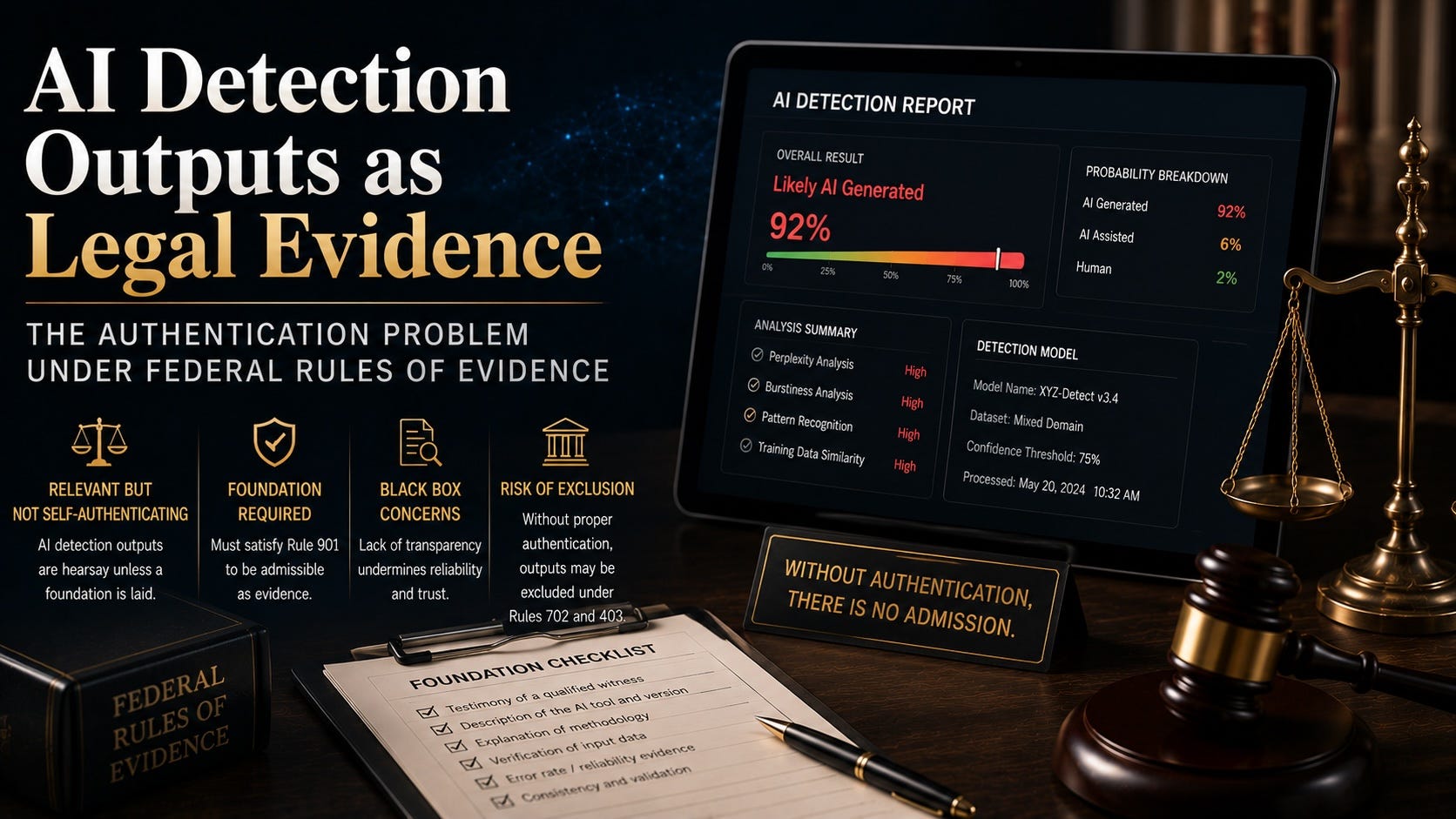
AI Detection Outputs as Legal Evidence: The Authentication Problem Under Rule 901
When a phishing detection system flags a message as malicious, when an intrusion detection system attributes an attack to a specific source, or when an authentication system logs a specific access event, those outputs may be introduced as evidence in civil, criminal, or regulatory proceedings. The controlling admissibility framework is Federal Rule of Evidence 901, which requires that the proponent produce evidence sufficient to support a finding that the item is what the proponent claims.
Rule 901’s threshold is preponderance-compatible: a reasonable factfinder must be able to conclude the evidence is more likely than not authentic. For AI-generated detection outputs, the typical foundation includes testimony about the system’s design and operation, its configuration at the relevant time, the chain of custody for the underlying data, and the system’s general acceptance in the field. Courts have applied this framework to traditional computer-generated records without significant difficulty, but AI detection outputs present a distinct problem: they are not records of what happened. They are probabilistic inferences about what the data suggests.
The Advisory Committee on Evidence Rules considered proposed Rule 901(c) at its November 2024 meeting. The proposal would implement a two-step authenticity challenge mechanism: the party challenging an item on grounds of AI fabrication must first produce evidence sufficient to support a finding of fabrication, then the burden shifts to the proponent to demonstrate by a preponderance that the evidence is authentic. The Advisory Committee declined to advance Rule 901(c) for public comment in 2024 and retained it on the agenda for fall 2025. No action has been announced as of this writing.
The structural gap is clear. Rule 901 was not designed to evaluate probabilistic inference outputs. A detection system reporting 87% confidence that an email is malicious is not authenticating a fact: it is generating a statistical prediction. Treating that prediction as an authenticated record, without a specialized foundation requirement, conflates detection confidence with evidentiary authentication in a way that no current federal rule addresses.
The Deepfake Evidentiary Gap: Detection Verdicts Without a Standard
The evidentiary problem reaches its sharpest form when AI deepfake detection outputs are introduced in judicial proceedings. Unlike a DNA probability or a fingerprint match, a deepfake detection verdict produced by a neural network carries no universally accepted methodology, no peer-reviewed error rate standard, and no recognized protocol for the forensic expert presenting it. Leading researchers in computer vision and AI forensics have stated that detection tools are not reliable enough to depend on, and that the advance of generative AI has outpaced the development of validated countermeasures.
Proposed Rule 707, approved for public comment by the Judicial Conference’s Advisory Committee in May 2025 by a vote of 8 to 1, would apply reliability standards analogous to expert witness requirements under Daubert to machine-generated evidence. The rule’s defining limitation is that it applies only where the proponent affirmatively acknowledges that the evidence was created by AI. Where the central dispute is whether the evidence was artificially generated, and where the proponent contests that characterization, Rule 707 does not engage the problem.
Professor Rebecca Delfino’s April 2025 submission to the U.S. Courts Advisory Committee, Deepfakes on Trial 2.0, proposes amending Federal Rule of Evidence 901 to create a targeted mechanism for contested AI-generated materials. The proposal would require any deepfake detection output offered as authentication evidence to satisfy reliability standards analogous to those under Daubert: testable methodology, peer review, and a known error rate. The Advisory Committee has not yet acted on the proposal.
Louisiana Act No. 250 (HB 178), effective August 1, 2025, is the most concrete state-level response to date. It imposes a diligence obligation on attorneys rather than a reliability standard on the evidence itself. An attorney who exercises reasonable diligence and submits AI-altered evidence in good faith may satisfy the Louisiana threshold while the detection output that supported that diligence determination goes unexamined by the court.
The September 2025 Alameda County dismissal illustrates the operational consequence of the gap. A court determined that videotaped witness testimony had been fabricated using deepfake technology and dismissed the case without any standardized detection protocol, without a controlling rule on the admissibility of the detection evidence, and without an established procedure for how the deepfake finding entered the judicial record. Courts across the country are beginning to encounter this question, and the absence of a standard governing these determinations creates inconsistent outcomes as each court addresses the problem independently.
Source List
1. Federal Rule of Evidence 901, 28 U.S.C. app. (2024): Controlling authentication standard for AI detection outputs in federal proceedings.
2. Federal Rule of Evidence 702, as amended December 1, 2023: Daubert reliability standard for expert testimony on AI-based systems.
3. Proposed Federal Rule of Evidence 707 (Machine-Generated Evidence): Released for public comment August 2025; comment period closed February 16, 2026.
4. Louisiana Act No. 250 (HB 178), effective August 1, 2025: First state statute requiring attorney diligence on AI-generated evidence.
5. Illinois Biometric Information Privacy Act (BIPA), 740 ILCS 14 (2008): Primary biometric privacy statute with a private right of action.
6. Daubert v. Merrell Dow Pharmaceuticals, Inc., 509 U.S. 579 (1993): Supreme Court precedent on reliability criteria for expert scientific evidence.
7. NIST IR 8596 (Preliminary Draft, December 2025): Cybersecurity Framework Profile for Artificial Intelligence.
8. Rebecca Delfino, Deepfakes on Trial 2.0 (SSRN, April 2025): Proposal to amend Federal Rule of Evidence 901 for deepfake detection evidence.
9. University of Baltimore Law Review, Deepfakes in the Courtroom (December 2025): Analysis of authentication challenges for AI-generated evidence.
10. Surveillance Accountability Act, H.R. 8470: Proposed amendment to Title 18 requiring warrants for automated digital surveillance.
11. Colorado Privacy Act biometric-specific obligations, effective July 1, 2025.
12. Judicial Conference Advisory Committee on Evidence Rules, November 2024 meeting on proposed Rule 901(c).
Bibliography
Biometric Update. U.S. Bill Would Require Warrants for Digital Surveillance and Biometric Searches. April 2026. https://www.biometricupdate.com/202604/us-bill-would-require-warrants-for-digital-surveillance-biometric-searches
Brightside AI. AI-Generated Phishing vs Human Attacks: 2025 Risk Analysis. 2025. https://www.brside.com/blog/ai-generated-phishing-vs-human-attacks-2025-risk-analysis
Colorado General Assembly. Colorado Privacy Act, biometric-specific obligations, effective July 1, 2025.
Daubert v. Merrell Dow Pharmaceuticals, Inc., 509 U.S. 579 (1993).
Delfino, Rebecca. Deepfakes on Trial 2.0: A Revised Proposal for a New Federal Rule of Evidence to Mitigate Deepfake Deceptions in Court. SSRN, April 2025. https://papers.ssrn.com/sol3/papers.cfm?abstract_id=5188767
Illinois General Assembly. Biometric Information Privacy Act, 740 ILCS 14 (2008).
Judicial Conference of the United States, Advisory Committee on Evidence Rules. Proposed Rule 707 (Machine-Generated Evidence). Released for public comment August 2025. https://www.uscourts.gov
Judicial Conference of the United States, Advisory Committee on Evidence Rules. Proposed Rule 901(c). Considered November 8, 2024.
Louisiana Legislature. Act No. 250 (HB 178). Effective August 1, 2025.
National Center for State Courts. AI-Generated Evidence Is a Threat to Public Trust in the Courts. 2025. https://www.ncsc.org/resources-courts/ai-generated-evidence-threat-public-trust-courts
National Institute of Standards and Technology. NIST IR 8596 (Preliminary Draft): Cybersecurity Framework Profile for Artificial Intelligence. December 2025. https://nvlpubs.nist.gov/nistpubs/ir/2025/NIST.IR.8596.iprd.pdf
Quinn Emanuel Urquhart and Sullivan, LLP. Adapting the Rules of Evidence for the Age of AI. 2025. https://www.quinnemanuel.com/the-firm/publications/adapting-the-rules-of-evidence-for-the-age-of-ai/
Thomson Reuters Institute. Deepfakes on Trial: How Judges Are Navigating AI Evidence Authentication. 2025. https://www.thomsonreuters.com/en-us/posts/ai-in-courts/deepfakes-evidence-authentication/
University of Baltimore Law Review. Deepfakes in the Courtroom: Challenges in Authenticating Evidence and Jury Evaluation. December 1, 2025. https://ubaltlawreview.com/2025/12/01/deepfakes-in-the-courtroom-challenges-in-authenticating-evidence-and-jury-evaluation/
U.S. Customs and Border Protection. Contract with Clearview AI, executed February 11, 2026. Contract value $225,000.