

Executive Summary
Quick Answer
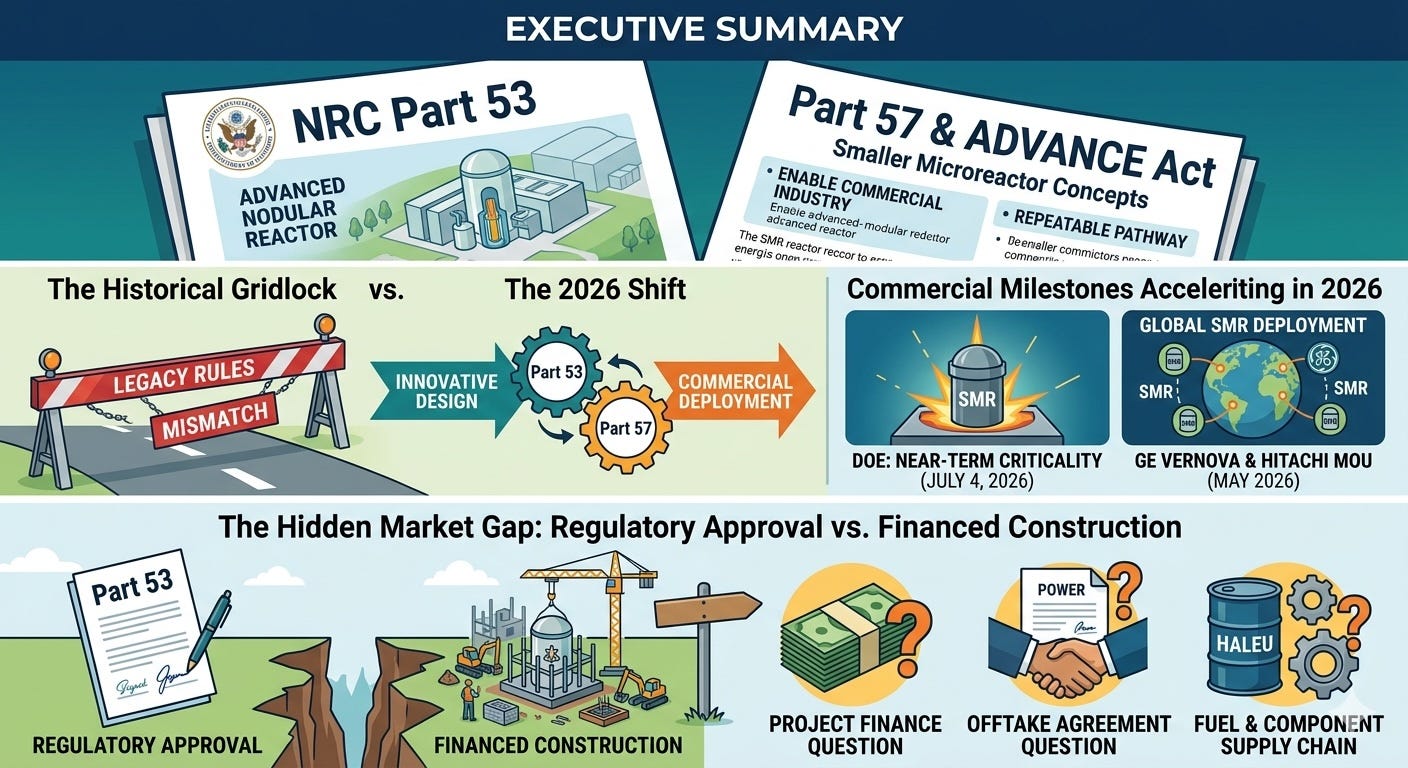
In late March 2026, the U.S. Nuclear Regulatory Commission (NRC) finalized Part 53 and proposed Part 57, establishing a transformative, repeatable licensing pathway for advanced nuclear reactors and microreactors. Mandated by the ADVANCE Act of 2024, this update shifts the NRC’s mission statement to explicitly include enabling commercial industry. However, while regulatory hurdles have changed fundamentally, a critical market gap remains: regulatory approval does not equal financed construction. Project developers must still navigate substantial capital, offtake, and supply chain barriers before achieving commercial scale.
The Historical Gridlock: Why 2026 is Different
For thirty-five years, developers of non-light-water advanced reactors encountered a systemic, structural brick wall. Every innovative nuclear design had to be evaluated under regulatory frameworks originally engineered for legacy, light-water technologies that the new reactors did not use. Worse, these rules were administered by an agency whose historic mission statement omitted any mandate to support or enable commercial development. This mismatch made repeatable, standardized deployment economically irrational.
Two monumental regulatory shifts in early 2026 completely dismantled this paradigm:
· NRC Part 53 & Part 57 Framework: The NRC finalized Part 53, introducing the first dedicated advanced reactor licensing pathway since 1989. Simultaneously, the agency proposed Part 57, a dedicated framework tailored specifically to scale microreactors efficiently.
· The ADVANCE Act Mission Shift: Codified via the ADVANCE Act of 2024, the NRC’s governing statement now explicitly includes enabling industry progress alongside safety, forcing a historic cultural and operational pivot.
These are not minor, incremental compliance updates. Licensing reform and accelerating commercial deployment are moving in tandem for the first time in over forty years.
Commercial Milestones Accelerating in 2026
The tangible impact of this regulatory modernization is already evident across the energy sector:
· Near-Term Criticality: The Department of Energy’s (DOE) Office of Nuclear Energy project and expect multiple advanced reactors to achieve criticality by July 4, 2026.
· Global SMR Deployment: International commercial activity is surging. In May 2026, GE Vernova and Hitachi finalized a memorandum of understanding (MOU) to actively identify commercial deployment opportunities for the BWRX-300 small modular reactor (SMR) across Southeast Asia.
The Hidden Market Gap: Regulatory Approval vs. Financed Construction
Despite historic structural breakthroughs, global financial markets have fundamentally failed to price the significant operational distance between achieving regulatory approval and initiating financed construction. Resolving the licensing pathway is a critical milestones, but it represents only one phase of commercial execution.
Strategic Insight for Investors:
For institutional investors, venture funds, and energy developers, reading the NRC’s Part 53 framework as a guarantee of commercial success is a mistake. It is a necessary but not sufficient condition for market scale.
To capture true market value, energy stakeholders must solve three unresolved commercial bottlenecks:
1. The Project Finance Question: Securing multi-billion-dollar project capital remains a high hurdle for unproven first-of-a-kind (FOAK) advanced reactors.
2. The Offtake Agreement Question: Commercial scalability requires long-term power purchase agreements (PPAs) or industrial offtake commitments to guarantee revenue streams.
3. The Fuel and Component Supply Chain: High-Assay Low-Enriched Uranium (HALEU) supply lines and standardized specialized component manufacturing are not yet fully operational at scale.
The Multi-Billion Dollar Question
The ultimate market winners will not be those who simply obtain a license under Part 53. The true leaders will be the developers, partners, and financial institutions that successfully close these remaining infrastructure gaps on an accelerated timeline.
References & Source Materials
Roll Call. (May 13, 2026). “Nuclear Regulatory Commission updates processes to meet new demands.” https://rollcall.com/2026/05/13/nuclear-regulatory-commission-updates-processes-to-meet-new-demands/
American Nuclear Society. (May 2026). “Industry Update: May 2026.” https://www.ans.org/news/article-7957/industry-updatemay-2026/
National Conference of State Legislatures. (May 2026). “News Reactor: May 2026.” https://www.ncsl.org/state-legislatures-news/details/news-reactor-may-2026